
Effective atomic number (Zeff) differentiation is one approach to extracting material-related information from spectral X-ray measurements. Rather than identifying a specific substance, Zeff helps characterize materials based on differences in their X-ray attenuation across energy ranges. In security and inspection applications, this information can help distinguish between material categories and provide additional context alongside conventional X-ray images.
The way effective atomic number information is generated, displayed, and interpreted varies by imaging technology. In spectral X-ray systems, energy-dependent attenuation information can be used to support material differentiation and classification without relying solely on the grayscale appearance of a conventional X-ray image.
What is effective atomic number differentiation?
Effective atomic number (Zeff) differentiation is a material characterization approach that uses differences in X-ray attenuation across energy ranges to provide information related to a material’s composition. Because materials interact differently with X-rays depending on energy, spectral measurements can be used to estimate material-related characteristics such as effective atomic number. This information can help differentiate materials beyond what may be apparent from conventional X-ray attenuation alone.
How does effective atomic number differ from conventional X-ray imaging?
Conventional single-energy X-ray imaging produces a grayscale image based on X-ray attenuation, which is influenced by factors including material composition, density, and thickness. As a result, different materials can sometimes produce similar appearances in a conventional X-ray image.
Effective atomic number differentiation adds material-related information by using differences in X-ray attenuation across different energy ranges. This can help distinguish materials that may be difficult to differentiate using conventional X-ray information alone. Rather than identifying a specific substance, effective atomic number provides an additional characteristic that can be considered alongside shape, attenuation, and other image information.
Why does effective atomic number matter for threat assessment?
Certain threat materials may exhibit effective atomic number characteristics that differ from surrounding materials. Zeff information can therefore provide operators with an additional material-related indicator alongside shape, attenuation and other image characteristics.
Does effective atomic number differentiation require multiple X-ray exposures?
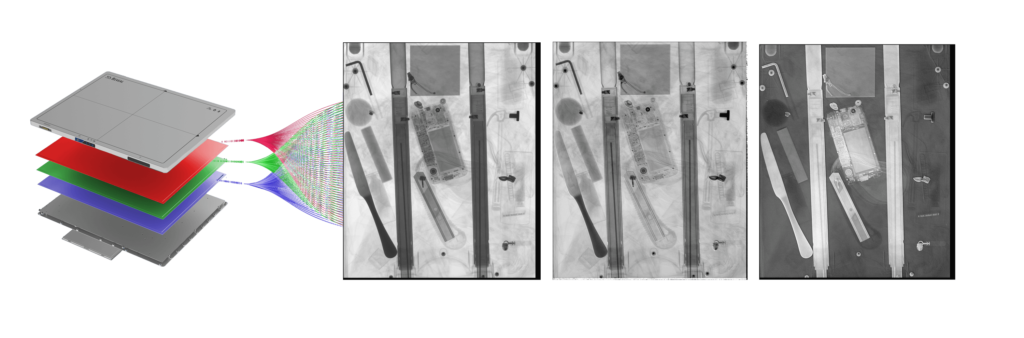
Not necessarily. Some dual-energy X-ray systems acquire separate exposures at different X-ray energy settings. When those exposures are acquired sequentially, movement between acquisitions can introduce image-registration or motion artifacts. KA Imaging’s SpectralDR® technology uses a stacked detector design to capture energy-separated information from a single X-ray exposure, avoiding the inter-exposure motion artifacts associated with sequential dual-exposure acquisition.
Can effective atomic number differentiation identify a specific material?
Not on its own. Effective atomic number differentiation provides information about a material’s X-ray attenuation characteristics, helping distinguish between materials with different atomic number ranges. However, different materials can have similar effective atomic number characteristics, so Zeff should not be interpreted as definitive identification of a specific substance.
How Spectral X-ray Imaging Can Support Effective Atomic Number Differentiation
KA Imaging’s SpectralDR® technology captures spectral information from a single X-ray exposure, enabling conventional and material-selective image outputs. In defense and security applications, this additional spectral information can support atomic number-based material differentiation alongside conventional X-ray visualization.
KA Imaging also offers a ruggedized version of this technology, known as the Reveal™ R 35C, which is built for field and industrial conditions. It carries an IP55 ingress rating, a reinforced enclosure, and mounting features such as a tripod quick-mount bracket and webbing strap points.
The Reveal™ R 35C can generate up to four images from a single exposure: conventional, high-density, low-density, and a colorized composite image that blends the material-differentiated data into one view.
The Reveal™ R 35C is also compliant with ASTM F792-17, a standard addressing performance testing of X-ray systems used for security screening.
5 Applications of Effective Atomic Number Differentiation in X-ray Screening
Effective atomic number differentiation can provide additional material-related information in applications where conventional X-ray attenuation alone may not provide enough information to distinguish between different materials. Rather than identifying a specific substance, Zeff-based differentiation can help classify or distinguish materials based on differences in their X-ray attenuation characteristics across energy ranges.
The value of this information depends on the imaging system, the materials being examined, and the inspection task. The following are five areas where atomic number-based material differentiation can support X-ray screening and inspection.
1. Explosives and Threat Assessment
In security screening, potentially threatening materials may be concealed among electronics, wiring, packaging, and other objects that create complex or overlapping X-ray images. Conventional X-ray imaging provides important information about an object’s structure and attenuation, but materials with similar appearances can be difficult to distinguish from that information alone.
Effective atomic number differentiation provides an additional material-related characteristic. Differences in spectral response can help distinguish material categories that may appear similar in a conventional X-ray image, giving operators additional information when evaluating suspicious or ambiguous objects.
This information does not independently identify an explosive or determine whether an object represents a threat. Instead, it can be considered alongside shape, attenuation, device construction, and other image characteristics as part of the operator’s assessment.
2. Baggage and Security Screening
Baggage screening often involves complex arrangements of overlapping objects made from different materials. Electronics, containers, personal items, and other contents can create areas that are difficult to interpret using a conventional grayscale X-ray image alone.
Effective atomic number differentiation can add material-related information to the inspection. By helping differentiate material categories, spectral X-ray imaging can give screening operators another characteristic to consider when examining complex or ambiguous areas of an image.
Colorized spectral images can also provide a visual representation of material differentiation, allowing material-related information to be viewed alongside conventional X-ray information.
3. Cargo and Border Inspection
Cargo and border inspection presents a different challenge: inspectors may need to evaluate layered or mixed-material contents while minimizing unnecessary disruption to legitimate shipments.
Spectral X-ray information can support these inspections by providing additional information about differences between materials within the object being examined. Atomic number-based differentiation can help operators distinguish material categories and identify areas that may warrant closer examination.
Portable spectral X-ray technology can also extend material differentiation beyond fixed inspection environments, supporting inspections at or near the point where suspicious cargo or objects are encountered.
4. Non-Destructive Testing and Industrial Inspection
Material differentiation can also be useful in non-destructive testing (NDT), where an inspection may involve multiple materials that are difficult to distinguish using conventional X-ray information alone.
Spectral X-ray imaging can provide additional material-related information, complementing conventional structural information. Depending on the inspection task, this can support differentiation between metals and lower-density materials, assessment of multi-material assemblies, and screening for concealed or unexpected components.
Because the usefulness of effective atomic number information depends on the materials being examined, the specific value of spectral differentiation will vary by NDT application.
5. Field-Deployable EOD Inspection
Explosive Ordnance Disposal places imaging equipment under operational demands that differ significantly from fixed or controlled inspection environments. Equipment may need to be transported to the object, positioned remotely, and operated under challenging field conditions. In EOD operations, minimizing unnecessary approaches, equipment repositioning and repeated acquisitions can be operationally valuable.
KA Imaging’s Reveal™ R 35C combines a ruggedized detector design with single-exposure spectral imaging. From one X-ray exposure, the detector can generate conventional and material-selective image outputs, providing additional material information alongside the conventional X-ray view.
The detector features an IP55-rated enclosure and mounting features including a tripod quick-mount bracket and webbing strap points. Because SpectralDR® captures spectral information from a single exposure, material-selective information can be obtained without the sequential exposures required by some dual-energy acquisition approaches.
For EOD operators, spectral material differentiation provides another source of information when assessing the construction and contents of a suspicious device.
Adding Material Information to X-ray Inspection
Effective atomic number differentiation provides another way of interpreting information contained in spectral X-ray measurements. By adding material-related information to conventional structural and attenuation characteristics, Zeff-based differentiation can give operators additional context when evaluating complex or ambiguous objects.
KA Imaging’s SpectralDR® technology captures energy-dependent X-ray information from a single exposure, enabling conventional and material-selective image outputs without requiring sequential dual-energy exposures. In rugged Reveal™ configurations, this capability can be deployed in demanding security, industrial, and EOD inspection environments.
To learn more about Reveal™ detectors and their available applications, contact KA Imaging.