
What Is Low Flux Imaging?
Low flux imaging refers to imaging conditions where only a limited number of X-ray photons reach the detector. This may occur intentionally — to protect radiation-sensitive samples — or naturally in research environments where signal levels are inherently low.
Low flux imaging is commonly used to:
- Minimize radiation exposure to delicate biological or material samples
- Enable longitudinal imaging studies with controlled dose
- Study low-density or weakly absorbing materials
- Perform high-resolution imaging where exposure must be limited
Under these conditions, detector performance becomes critical. With fewer photons available, image quality depends on the detector’s sensitivity, noise performance, and efficiency.
Why Detector Design Matters in Low Flux Imaging
Conventional indirect X-ray detectors use a scintillator to convert X-rays into visible light before detection. This additional conversion step can introduce signal spread and reduce efficiency, particularly when working with limited photon flux.
BrillianSe uses a fundamentally different approach.
BrillianSe is a direct conversion X-ray detector based on amorphous selenium (a-Se), which converts incoming X-ray photons directly into electrical charge without an intermediate light conversion step. This architecture helps preserve signal integrity and spatial precision — key advantages when imaging at low flux.
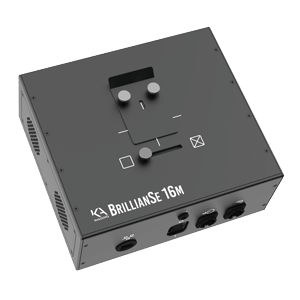
How BrillianSe Enables High-Quality Imaging in Low Flux Conditions
High Detection Efficiency
BrillianSe is designed to efficiently detect X-rays across a wide range of energies, with quantum efficiency reaching:
- 90% at 20 keV
- 29% at 40 keV
- 11% at 60 keV
This high detection efficiency allows the detector to capture meaningful signal even when fewer photons are available, supporting imaging in low flux environments.
Ultra-High Spatial Resolution
BrillianSe features 8 µm pixels, significantly smaller than many conventional X-ray detectors.
This enables:
- Visualization of extremely fine structures
- Improved defect detection
- High-precision imaging for micro-CT and materials research
High spatial resolution is especially valuable in low flux conditions, where preserving detail from limited signal is essential.
High Detective Quantum Efficiency (DQE)
Detective Quantum Efficiency (DQE) describes how effectively a detector converts incoming photons into useful image signal.
BrillianSe achieves:
- 36% DQE at 10 cycles/mm at 60 kVp
This performance supports imaging applications where photon availability is limited, such as diffraction-based microstructure imaging and throughput-limited experiments.
Low Noise CMOS Readout
BrillianSe integrates its amorphous selenium sensor directly with a custom CMOS readout chip. This hybrid design supports low electronic noise and precise signal measurement, helping maintain image clarity in low flux conditions.
Low noise performance is essential when working with limited photon signal, as it improves the ability to distinguish meaningful image features.
Supporting Phase-Contrast Imaging of Low-Density Materials
BrillianSe is compatible with propagation-based phase-contrast imaging techniques, which can enhance visualization of low-density structures that are difficult to detect with conventional absorption-based X-ray imaging.
This capability enables improved sensitivity when imaging:
- Soft biological tissues
- Composite materials
- Pharmaceutical structures
- Agricultural samples
Phase-contrast imaging is particularly valuable in low flux conditions, where maximizing information from available photons is critical.
Applications Where Low Flux Performance Is Essential
BrillianSe supports a wide range of research applications that benefit from efficient imaging at low photon flux.
These include:
Materials Science and Additive Manufacturing
High-resolution imaging enables visualization of:
- Microstructure
- Porosity
- Inclusions
- Internal defects
Micro-CT and Nano-CT
The detector’s spatial resolution supports detailed three-dimensional imaging of small structures.
Biomedical and Pharmaceutical Research
BrillianSe enables non-destructive imaging of:
- Biological specimens
- Medical devices such as stents
- Pharmaceutical capsules
Diffraction-Based Imaging
The detector’s efficiency supports imaging workflows where photon flux is inherently limited.
Why Direct Conversion Detectors Offer Advantages in Low Flux Imaging
Direct conversion detectors like BrillianSe offer several advantages over conventional scintillator-based systems in low flux environments:
- Higher spatial precision
- Improved signal preservation
- Reduced signal spread
- Greater detection efficiency
These characteristics help researchers obtain high-quality images without requiring increased exposure.
Choosing the Right Detector for Low Flux Research
Low flux imaging is essential across many advanced research fields. Achieving reliable results requires detectors designed to efficiently capture and preserve limited signal.
BrillianSe’s direct conversion architecture, high detection efficiency, and ultra-high spatial resolution make it well suited for:
- Micro-CT and nano-CT
- Materials research
- Phase-contrast imaging
- Diffraction-based imaging
By enabling efficient imaging at low photon flux, BrillianSe supports research workflows where signal efficiency and spatial precision are critical.
Learn More About BrillianSe
To learn how BrillianSe can support your research imaging needs, contact the KA Imaging team.