
The Growing Demand for Advanced Airport IED Detection
Airports face growing pressure to respond quickly to security threats without disrupting daily operations. While large fixed scanners play an important role, they are not always practical when a suspicious item is found outside standard screening areas. When it comes to airport Improvised Explosive Device (IED) detection outside of standard screening areas, portable imaging is critical.
Dual-energy X-ray systems are well established in airport security, but their use has traditionally been confined to fixed screening environments. Bulky and heavy, these systems are poorly suited for rapid deployment beyond checkpoint infrastructure. Portable spectral imaging, by contrast, provides security teams and emergency responders with the flexibility to assess threats where they arise. By enabling the detection of subtle and sophisticated threats through spectral separation, it supports fast, informed decision-making—without the need for prolonged operational shutdowns.
Until recently, true portability and dual-energy capability could not be combined. This changed with the development of SpectralDR technology, which enables dual-energy imaging from a single standard X-ray exposure.
Reveal R 35C, powered by SpectralDR technology, brings dual-energy capabilities into a compact, portable form factor, enhancing material discrimination and image clarity without sacrificing speed or flexibility. For airport IED detection, where mobility, rapid assessment, and image confidence are essential, these capabilities matter.
In this article, we explore the current state of airport IED detection and examine why portable dual-energy X-ray systems like Reveal R 35C are redefining what’s possible beyond the checkpoint.
What Is Airport IED Detection?
Airport improvised explosive device (IED) detection refers to the identification and assessment of potential explosive threats within airport environments. It is a specialized form of Explosive Ordnance Disposal (EOD) activity that supports aviation security operations involving passengers, cargo, aircraft, and airport infrastructure.
Handling large volumes of international passengers and cargo each day, airports have historically been considered high-risk locations for explosive threats.
Airport security is responsible for detecting improvised explosive devices (IEDs) that may be concealed in luggage, cargo, equipment, or unattended items. These items often include a mix of organic materials, metals, wires, batteries, and shielding designed to confuse standard imaging.
To respond effectively, airport security and EOD teams require imaging tools that allow them to assess potential threats quickly, safely, and in the location where the item is found, without disrupting airport operations unnecessarily.
The Role of X-ray Imaging in Airport IED Detection
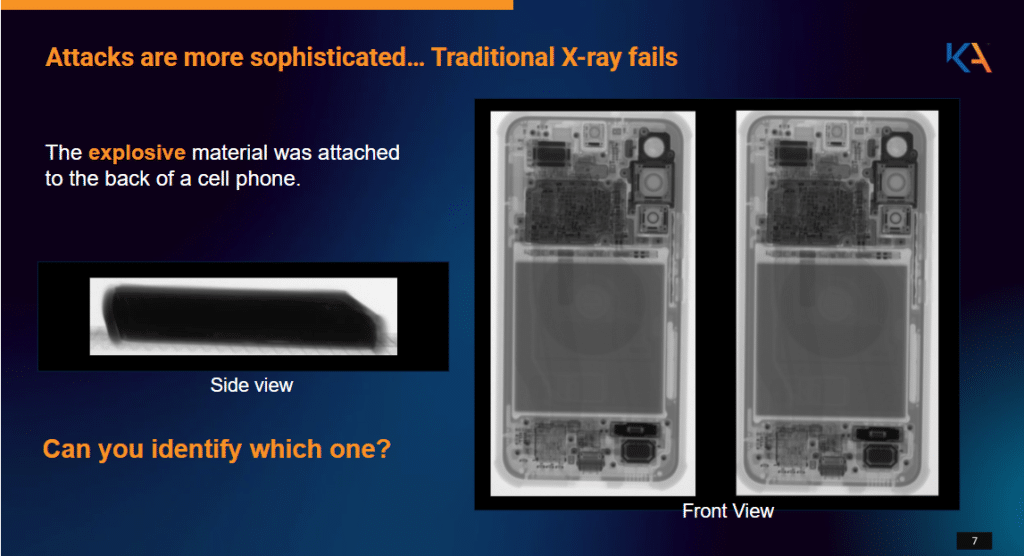
X-ray imaging plays a critical role in airport IED detection by allowing operators to see inside suspicious objects without physical intrusion. Traditional X-ray systems provide structural information such as shape, density, and internal components, which can help identify potential triggers, wiring paths, or concealed compartments.
However, standard single-energy X-ray images offer limited material information. Overlapping items, shielding, and mixed materials can obscure key details, often requiring experienced operators to rely on interpretation and inference, particularly in complex or cluttered scenes.
This limitation becomes more pronounced when suspicious items are found outside fixed screening zones, where large, stationary scanners cannot be deployed.
Why Dual-Energy X-ray Matters for Airport Security
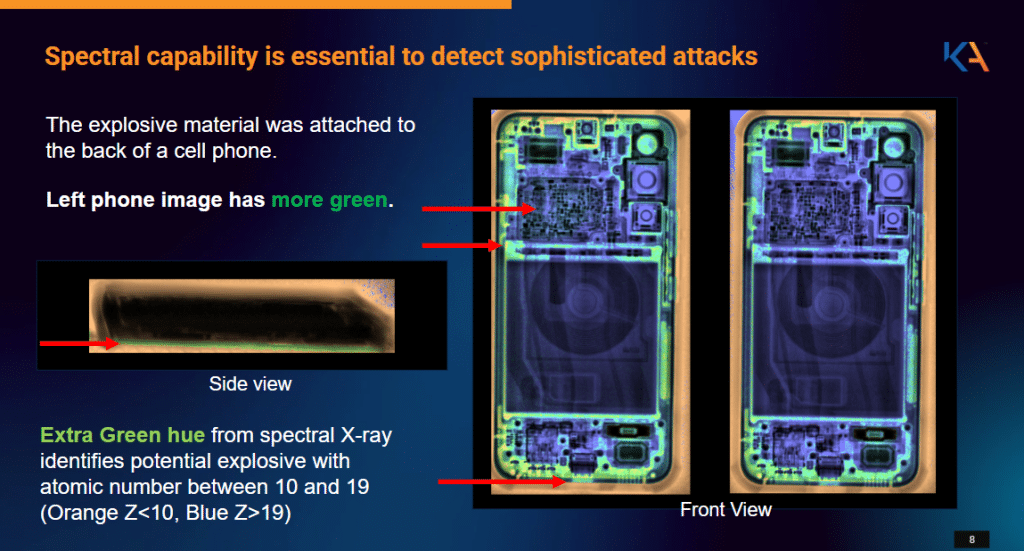
Dual-energy X-ray imaging improves threat assessment by separating materials based on how they interact with X-rays at different energy levels. This allows operators to better distinguish between organic materials (often associated with explosives) and inorganic components such as metals, wiring, or casings.
In airport IED detection, this added layer of material information can significantly improve interpretation confidence, especially when devices are deliberately designed to mask or blend components.
Historically, dual-energy X-ray systems in airports have been limited to large, fixed installations at checkpoints or cargo screening areas. Their size, weight, and infrastructure requirements make them unsuitable for rapid deployment in secondary inspection scenarios or non-traditional screening locations.
Reveal R 35C: Bringing Dual-Energy X-ray Beyond the Checkpoint
Until recently, combining true dual-energy capability with portability was not feasible. Most dual-energy systems rely on dual exposures, requiring two nearly identical scans to generate material-separated images. This approach introduces operational challenges in dynamic environments, where motion, positioning constraints, and time pressure make consistent repeat exposures difficult.
Advances in detector technology have made a different approach possible. Single-exposure dual-energy imaging captures all spectral information in one standard X-ray exposure, enabling faster, more reliable imaging without added procedural complexity.
Reveal R 35C is a portable X-ray detector that brings true single-exposure dual-energy imaging into field-deployable security operations. Powered by SpectralDR technology developed by KA Imaging, it enables material-separated imaging in a compact form factor designed for mobile use.
By generating multiple image types from a single exposure—including standard radiographic images, low-density views, high-density views, and colorized material maps—Reveal R 35C provides additional context beyond shape alone. This helps trained operators better interpret complex internal structures and mixed materials commonly found in improvised explosive devices.
How Dual-Energy Improves Airport IED Detection
Here is how Reveal R 35C improves airport IED detection as a portable X-ray system with true single-exposure dual-energy capability:
Material Differentiation
Dual-energy imaging separates materials based on how they absorb X-rays at different energy levels. This helps operators identify organic materials that may indicate explosives, while clearly outlining inorganic components such as wiring or metal casings.
Reduced Guesswork
Single-energy images provide limited information compared to our dual-energy solution. Airport security can examine shape and structure, but there’s no clear indication of what each item is actually made of. Airport security needs to rely on guesswork as a result.
Dual-energy images generated by Reveal R 35C provide more context than shape. With a clearer idea of what each item is made of, trained professionals can make more informed decisions.
Faster Threat Assessments
When an X-ray image provides limited information, more time is needed to interpret images. With the high-stakes nature of IED detection, there’s no room for error, and failure simply isn’t an option.
The additional information provided with Reveal R 35C supports faster decision-making during time-sensitive security operations, which minimizes airport disruption.
Key Features for Airport and EOD Applications
Portability
When there’s an explosive risk, X-ray portability is very important. Moving the object through public, highly-populated spaces is risky and poses a danger to everyone in the airport. Reveal R 35C as a portable imaging solution removes this risk, allowing operators to bring imaging directly to the object of concern.
Reveal R 35C is specifically designed with portable applications in mind. As such, portable use introduces no limitations to the X-ray power or dual-energy capabilities. It’s just as powerful in portable applications as it is in fixed applications.
High Image Quality
Higher image quality visualizes finer details, like detonators, wiring paths, and internal compartments. In short, higher image quality means more information about the object is being translated to the operator. This leads to better decision-making in terms of how the object is handled and whether it’s flagged as dangerous.
Single-Exposure Dual-Energy Imaging
Single-exposure dual-energy imaging by the Reveal R 35C supports reliable operation in real-world security environments. By avoiding dual-exposure workflows, it reduces susceptibility to motion artifacts and eliminates the need for repeat scans, making it well suited for dynamic, on-demand deployment.
Airport IED Detection Challenges in Modern Airports (and How Reveal R 35C Solves Them)
- Limited Space: Suspicious items are not always found in controlled screening areas. Tight corridors, aircraft cabins, and service zones limit the use of large equipment.
- The Reveal R 35C addresses space limitations with a portable, compact design, allowing deployment in areas where fixed scanners cannot reach.
- Time Pressure: Security incidents demand quick answers. Delays increase risk, disrupt operations, and strain resources.
- The Reveal R 35C is made to be deployed quickly and easily, eliminating any unexpected delays in image capture. Combined with fast processing times, airport security can respond to threats at a rapid pace.
- Safety Concerns: Moving a potentially dangerous device increases risk to staff and the public. Imaging should be done where the item is found to prevent safety risks.
- Being portable, the Reveal R 35C prevents movement of potentially dangerous objects through the airport. Instead, airport security can bring it straight to the object, enabling on-site imaging.
- Complex Device Construction: Modern IEDs are designed to avoid detection, using mixed materials and layered shielding that can be difficult to interpret with basic imaging tools.
- Reveal R 35C’s dual-energy imaging helps airport security interpret complex internal structures more clearly, even when devices use mixed or concealed materials.
Advancing Airport IED Detection Capabilities
As airport security threats continue to evolve, so must the tools used to detect and assess them. Reveal R 35C, our portable dual-energy X-ray imaging solution, extends advanced material discrimination beyond fixed checkpoints, supporting flexible, real-world threat assessment wherever it is needed.
By combining portability with single-exposure dual-energy imaging, Reveal is helping airport security and EOD teams respond more effectively, without slowing operations or increasing risk.